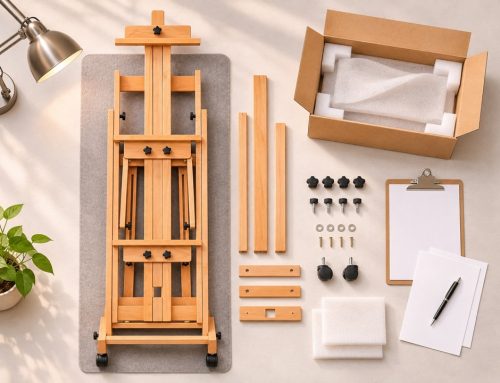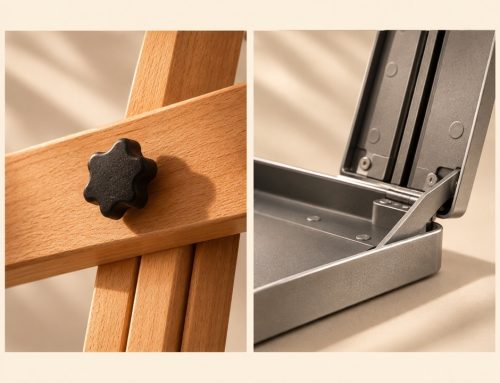

An art easel assortment should cover the ways customers actually paint: at a table, at a dedicated studio station, or away from the studio. Start with one defensible offer for each important use case. Add a second model only when it solves a different problem, such as fitting deeper canvases, folding into a smaller space, or working at an angle the first model cannot reach.
For a retailer or distributor, the aim is not to stock every type of easel. It is to make each choice clear enough that a customer can tell why two models belong on the same shelf.
Build the range around four jobs
| Job | Candidate format | What distinguishes a useful first SKU |
|---|---|---|
| Paint on a shared table | Tabletop easel | Fits the available work surface and securely holds the panel sizes customers already buy |
| Paint at a dedicated studio station | Floor-standing H-frame or lyre easel | Working height, open footprint and support range match the setting |
| Carry a setup outdoors | Field easel, French easel or pochade box | Carry weight and included components are clear for the exact configuration |
| Display a finished piece | Display easel | Fits the display task; not presented as a substitute for a working easel |
These are jobs, not four mandatory inventory categories. A teaching-focused retailer might need two tabletop formats and no display offer. A store serving studio painters might need different canvas capacities before it needs another finish. The Phoenix artist easel guide explains the formats; this assortment framework helps decide which ones to carry.
Give every additional SKU a reason to exist
Write a single sentence for each candidate: “This model is for a buyer who needs ___ and cannot get it from ___.” If the blanks can only be filled with “better quality” or “a nicer finish,” the range may already cover the job. A finish can justify another SKU when the channel needs it, but it does not replace a missing format or working range.
For example, a classroom-oriented assortment might use a tabletop model for shared desks, a folding floor easel for rooms that are cleared between sessions, and a studio easel for a demonstration station. Before ordering, walk through the room reset: where the folded units go, who moves them, and whether the demo position leaves space for students to see. That exercise gives a buyer more than a generic beginner-to-professional ladder.
Standardize the information before listing
Use a common set of fields across the assortment: intended use, assembled footprint, minimum and maximum supported size where available, panel or canvas depth, working angle, net weight, carton dimensions, and contents. Add fields that matter only to a specific format, such as tripod compatibility for a pochade box. Keep carton dimensions separate from folded and working dimensions.
Write the same configuration name on the quote, listing and carton where possible. If one SKU is box-only and another includes a tripod, photographs and included-items lists should make the difference clear without requiring customers to read the fine print.
Frequently asked questions
Should a first assortment include both H-frame and A-frame easels? Only when the channel can explain two distinct jobs. Compare room layout, canvas formats and storage requirements before treating both structures as essential.
Should a display easel sit in the painting range? It can share a category page, but label it separately when its intended use or adjustment range differs. Do not imply painting suitability without checking the model.
Plan the first order
Review the Phoenix easel collection, then request the current easel catalogue. Include your channel, the canvas formats you sell, and whether your priority is tabletop, studio or outdoor painting.
Related Posts