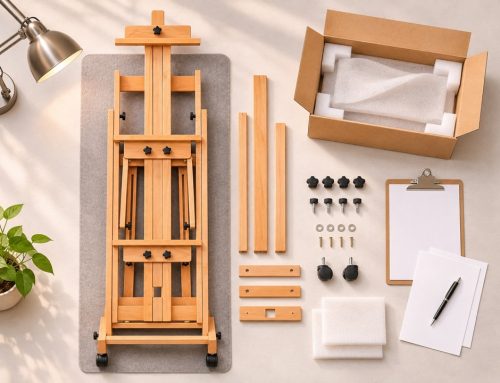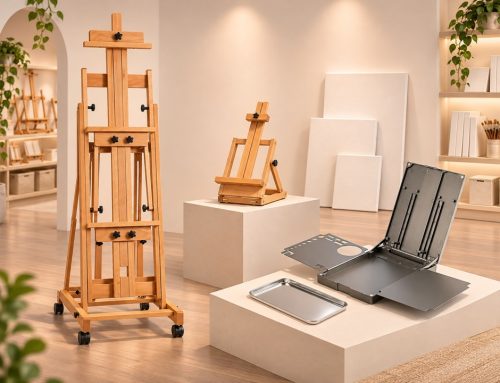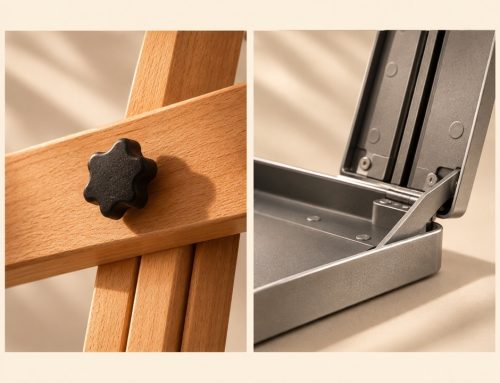
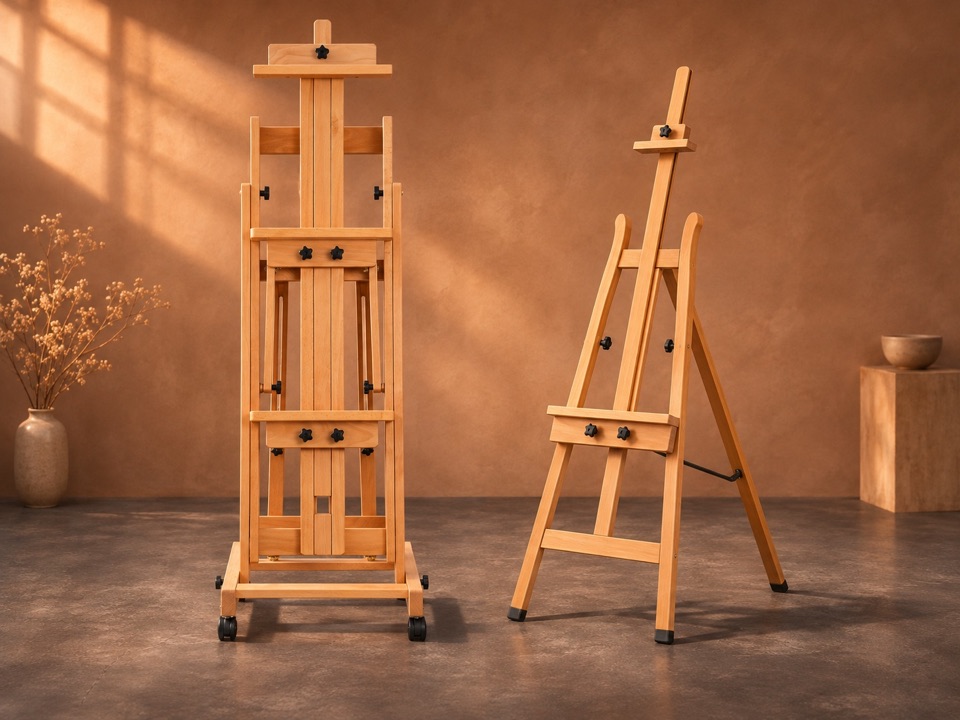
An H-frame easel is usually the first option to evaluate for a dedicated painting station with larger supports. An A-frame, often called a lyre easel, is worth evaluating where stations need to be rearranged or stored. Neither shape guarantees a particular canvas capacity, footprint, or working angle. Those are model specifications, not properties of the letter in the name.
Compare workstations, not just frame shapes
An H-frame typically has upright members and crossbars mounted on a rectangular base. An A-frame typically has two legs at the front and a rear support. Both can have adjustable canvas supports; the range and method depend on the model.
| Decision | H-frame question | A-frame question |
|---|---|---|
| Floor space | How wide and deep is the open base, and what changes when the frame tilts? | How far does the rear leg project in the working position? |
| Canvas fit | Does the mast clear the ceiling at the required tray setting? | Does the tray and upper support fit the actual canvas depth as well as height? |
| Shared use | Can users reach the controls at the intended working heights? | Can staff reset the rear leg and tray consistently between classes? |
| Moving and storage | Is movement by lifting or by casters, and how is the unit secured for use? | Does the model actually fold, and what are its folded dimensions? |
An open base measurement is more useful than a claim that one design is always compact. In a narrow room the rear leg can be the limiting dimension, while a tall mast may be the constraint under low ceilings or lights.
Match the position to the work
For oil and acrylic, compare the support needed for the usual canvas sizes and the pressure artists apply while working. For washes, ask whether the model can reach the shallow angle the lesson requires; do not infer this from an “adjustable” label. If a pastel or drawing program wants forward tilt, confirm that motion separately from backward tilt. Fit a sample support before relying on any stated angle or size.
Choose for the room and the channel
Shared classroom. Set out the planned number of stations on paper first. Include chair movement, access to the rear support, and the route to storage. Evaluate whichever frame passes the full room exercise.
Dedicated studio. Define the canvas sizes and working heights first. A fixed-location H-frame may make sense, but compare clearance and access to the adjustment hardware before choosing a large model.
Art retail. Use the two forms to explain two different use cases. Label the open footprint and folding capability separately so buyers can compare them without guessing from a photograph.
You can review Phoenix lyre easel examples and see one specific H-frame configuration in the Phoenix W14A studio demonstration. The video illustrates a retail model; it does not establish equivalent specifications across the wholesale range.
Frequently asked questions
Is an H-frame automatically more stable? No. Frame shape is a useful starting point, but joints, base contact, load position and adjustment locks all matter. Compare samples in the intended position with the same type of painting support.
Do all A-frame easels fold for storage? No. Ask for the folding method and packed-away dimensions for the exact model rather than assuming that a rear leg means easy storage.
Request a model comparison
Browse the Phoenix easel range and request comparable model specifications. Share the room layout, canvas sizes and storage restrictions so the comparison starts with your actual constraints.
Related Posts