
To evaluate an H-frame studio easel, check three things separately: what it can hold, where it can fit, and what can be adjusted once it is in use. Maximum canvas height alone does not answer any of those questions completely. Ask for a model-specific drawing and check the intended canvas or panel on a sample before signing off.
Put the measurements in the right columns
| Specification | What to record | Why it matters |
|---|---|---|
| Overall height | Minimum and maximum assembled height; mast position at each measurement | Verifies room clearance |
| Working height | Lower holder height above the floor at the intended setting | Relates the canvas position to seated or standing work |
| Support envelope | Minimum and maximum supported height, acceptable depth, and relevant clamp geometry | Distinguishes a deep stretched canvas from a thin panel |
| Open footprint | Base width and depth, with extra clearance for controls or tilt | Prevents layout decisions based on carton dimensions |
| Working angle | Angle range and whether it is measured from vertical or horizontal | Avoids comparing unlike numbers |
| Rated load | Applicable model, load position and test conditions, if supplied | Keeps an unqualified load number from becoming a blanket promise |
Use inches and centimeters on the buyer sheet where useful, but keep one agreed reference unit for sample approval. A catalogue reference size should not be relabeled as maximum canvas size. Similarly, a horizontal work position is a specific capability, not a synonym for adjustable tilt.
Inspect how the adjustment works
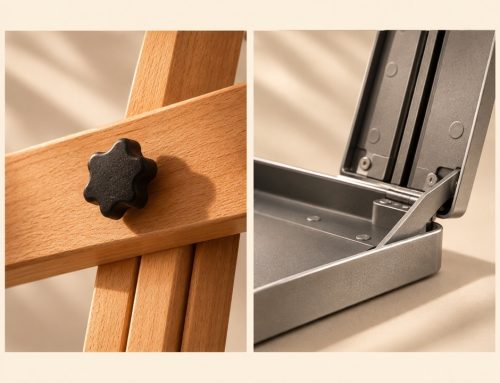
Check the mast and lower holder through the intended operating range, following the model instructions. Look for binding, slip after locking, or a knob that becomes inaccessible with the actual support in place. Verify that both the upper and lower holders engage where intended. A support that just fits between two points may still be unsuitable if the contact or grip is wrong.
If the easel has casters, check movement and locking separately on the intended floor surface. Confirm which casters lock and what the mechanism locks. Do not extrapolate from an unloaded demonstration to moving a loaded easel; follow the manufacturer’s instructions for transport and adjustment.
Make a sample check repeatable
Record the SKU and revision, the support used, how the easel was configured, and what was observed. Use a typical support and a representative example near the intended limit without exceeding the documented rating. Check that the agreed controls are still accessible and that the easel stays in the selected position during normal use. If the buyer requires a formal load or durability test, agree on a method and acceptance criteria separately.
The Phoenix W14A studio video illustrates how one retail model is presented in use. Use it as a training example, not as a substitute for the specification sheet of the model being ordered.
Frequently asked questions
Is maximum canvas height the same as maximum overall height? No. One describes the support the holders can accommodate; the other describes how much vertical space the easel occupies.
Can two models with the same published tilt range be treated as equivalent? Not without confirming angle convention, the locking positions, and clearance with the intended support.
Get the specification sheet
Review the Phoenix easel collection and request specifications for the model under consideration. Include the support dimensions, working angle and room-clearance requirements your buyers need to meet.
Related Posts