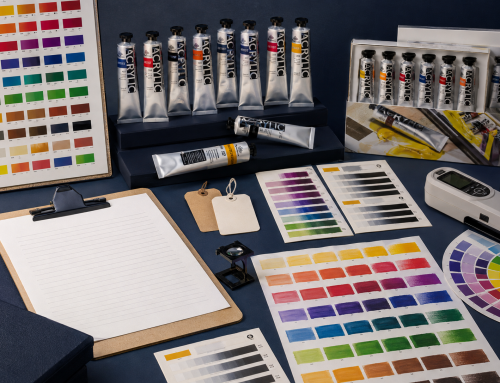
Lightfastness is a colourant’s resistance to change under defined light exposure. Permanence is broader: it concerns how well the finished colour and paint system resist material change over time under expected conditions. A lightfast pigment is important, but it does not make every paint film, support, application or storage condition permanent.
Lightfastness and permanence answer different questions
| Term | Main question | Important limitation |
|---|---|---|
| Lightfastness | How resistant is the colourant to change under a stated light-exposure method? | Does not evaluate every ageing mechanism |
| Permanence | How durable is the colour in its complete material and use context? | May combine several evidence sources and brand-specific rating logic |
| Durability of an artwork | How does the whole object respond over time? | Depends on paint, ground, support, layer structure, environment and care |
The words should not be merged into one unqualified “archival” promise.
What does ASTM D4303 cover?
ASTM D4303 is titled Standard Test Methods for Lightfastness of Colorants Used in Artists’ Materials. ASTM describes accelerated exposure methods using natural daylight behind glass and specified artificial-light sources to approximate colour change expected under normal indoor exposure.
This tells us two things:
- the test concerns lightfastness of colourants used in artists’ paints; and
- a published rating needs a stated method and interpretation.
See the official ASTM D4303 scope and the current standard listing through ASTM Subcommittee D01.57.
Do not assume that a star, plus sign or Roman numeral on one brand’s chart is an ASTM category. Read that chart’s legend.
Why brand rating systems cannot be compared by symbol alone
Manufacturers may publish:
- ASTM lightfastness categories;
- internal lightfastness categories;
- broader permanence ratings;
- separate symbols for opacity and durability; or
- region-specific label information.
Winsor & Newton, for example, publishes both permanence and lightfastness fields for its Artists’ Oil Colours and explains that its permanence assessment considers more than one factor. That structure is helpful, but its specific legend applies to Winsor & Newton products. See Terms Explained.
Phoenix must publish its own approved legend. A +++ notation, if used, should never be converted into ASTM I unless Phoenix has documentation confirming that exact equivalence.
What else affects permanence?
Binder and formulation
The vehicle influences film formation, yellowing, flexibility, gloss and drying. Different pigments also interact differently with oil. A pigment rating cannot by itself describe the whole paint film.
Film thickness and layer structure
Very thick, thin or poorly structured layers can age differently. Medium additions and the relationship between lower and upper layers affect drying and mechanical behaviour.
Ground and support
Sizing, priming or ground, absorbency, support stiffness and adhesion all contribute to the painting system. Paint applied to an unsuitable or unprepared support can face problems unrelated to pigment fading.
Environment
Light intensity and spectrum, exposure duration, heat, humidity, pollutants and rapid environmental changes all influence ageing.
Display, storage and handling
Transport, surface contact, dust, cleaning, framing and storage can damage a work even when the colourants are lightfast.
How to read a durability field responsibly
Use this sequence:
- Identify the exact product series and colour.
- Read the pigment code or codes.
- Find the rating symbol.
- Locate the manufacturer’s legend.
- Determine whether it describes lightfastness, permanence or both.
- Check whether a standard and version are named.
- Review limitations, unavailable ratings or special warnings.
- Retain the source document and revision date.
Read Colour Names vs Pigment Codes for the related label fields.
What buyers and product teams should request
For an artist-colour evaluation, ask for:
- a current colour chart for the exact series;
- pigment code or codes by colour;
- the full lightfastness/permanence legend;
- the applicable test basis or supplier evidence;
- opacity categories;
- current SDS and label warnings;
- revision control for formula and artwork changes;
- confirmation of which certifications apply to the product and market.
Do not turn an organisation-level certificate into a colour-level permanence claim. Do not apply one product’s test result to an entire category.
What artists can do
Artists cannot control every ageing variable, but they can make better-informed choices:
- read colour-level data rather than relying on the front name;
- use supports and grounds intended for oil painting;
- follow sound layer-building and medium practices;
- avoid unnecessary high-intensity light and unstable environments;
- retain material records for important work;
- seek conservation advice for valuable or unusual objects.
The takeaway
Lightfastness is essential evidence about colour change under light. Permanence is the larger durability question. A credible label says which one is being rated, identifies the legend and avoids promising more than the test supports.
Review the Phoenix Oil Color range and the download centre. For series-specific documentation, contact Phoenix Art Materials.
FAQ
Is ASTM I the same as “permanent”?
Not automatically. ASTM lightfastness and a manufacturer’s permanence category may be related, but the definitions and legend must be read separately.
Does a lightfast pigment guarantee an archival painting?
No. The binder, support, ground, layers, environment and care also matter, and archival should not be used as an unlimited guarantee.
Can I compare stars and plus signs across brands?
Only after reading each brand’s legend and test basis. Similar-looking symbols may mean different things.
Does opacity affect lightfastness?
They are different properties. Film thickness can affect the visible result of exposure, but an opacity symbol is not a lightfastness rating.
Related Posts