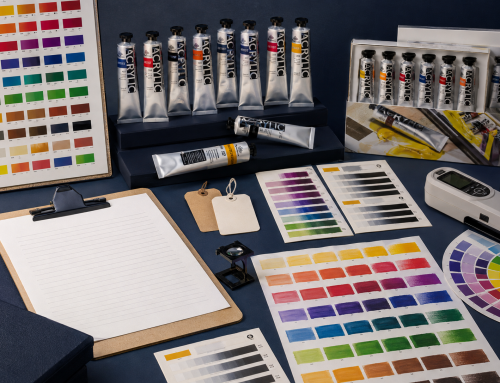
An art-supplies product should not move directly from inspiration to packaging artwork. Paint, canvas and tool programmes contain interacting decisions: user, medium, performance, format, colour or surface range, label, market documentation, case pack and quality acceptance.
A controlled workflow reduces ambiguity by creating one approved reference at each stage. The essential sequence is: commercial brief → technical specification → sample → use-case validation → packaging → pre-production approval → production release.
Stage 1: Define the user and product job
Begin with one sentence that explains who the product serves and what it must enable. “Acrylic set” is not a useful brief. “A compact acrylic set for adult beginners completing guided canvas projects at a defined retail price” gives the team something to design and test.
The brief should cover:
- target customer and channel;
- intended medium, technique or subject;
- price architecture and competitive frame;
- required format, count and size;
- markets and languages;
- replenishment expectations;
- launch timing and approval owner.
This stage should also identify what the product is not. A classroom set, specialist artist range and gift product require different decisions even when they share colours.
Stage 2: Translate the idea into measurable specifications
Replace adjectives with criteria. “High quality” cannot be inspected. A specification can define dimensions, material, colour identity, viscosity range or handling target, fill, tolerance, finish, packaging and applicable document requirements.
For paint, useful fields may include pigment code, opacity, lightfastness basis, colour standard, consistency, drying behaviour, container and net contents. For canvas, they may include fibre, fabric weight, weave, sizing/ground, width or dimensions, frame profile, tension and packing.
Do not claim a performance standard or certification unless it applies to the exact product and market.
Stage 3: Build the range architecture
A product rarely stands alone. Decide how it relates to adjacent sizes, colours, surfaces and price points.
Ask:
- Does every SKU have a distinct role?
- Which items drive the first purchase?
- Which colours or sizes need open-stock replenishment?
- Can retailers explain the step-up between ranges?
- Will packaging and product names remain consistent across languages?
- Does the new item overlap an existing range without adding value?
For a colour set, approve colour roles before final names. For canvas, approve application, surface and size logic before adding multiple internal grades.
Stage 4: Review documents before physical sampling
Collect the information needed to interpret the sample:
- product specification and revision;
- materials or pigment declaration where applicable;
- label fields and symbol legends;
- applicable safety and compliance documents;
- packaging drawings and dielines;
- test method or internal comparison procedure;
- change-control expectations.
Document review can reveal conflicts early. A colour chart may show one pigment code while a label artwork contains another; a carton drawing may use a unit count that no longer matches the commercial brief.
Stage 5: Approve physical samples in layers
One attractive “golden sample” is not enough. Separate the questions.
| Sample | Decision |
|---|---|
| Material or formula sample | Does the core paint, canvas or tool meet the technical target? |
| Range sample | Do colours, sizes or surfaces work together? |
| Use-case sample | Can the intended artist or class complete the stated task? |
| Packaging mock-up | Is information accurate, readable and physically workable? |
| Pre-production sample | Does the final combination match all approvals? |
Record results with dates, item references, conditions and decision owners. Verbal comments such as “make it warmer” should become a controlled colour target or approved comparison sample.
Stage 6: Validate the real user task
Laboratory or incoming checks and artist-use trials answer different questions. A drawdown can compare opacity and colour; a painting exercise can show whether a set supports a useful workflow. A frame measurement can confirm dimensions; a handling trial can reveal bounce, corner damage or packaging abrasion.
Use both where relevant, and do not present a creator demonstration as proof of lightfastness, batch consistency or regulatory compliance.
Stage 7: Freeze packaging and market information
Packaging should be approved only after the product definition is stable. Confirm:
- brand, range and product names;
- item code, barcode and pack quantity;
- pigment, material or surface information where declared;
- net contents and dimensions;
- languages, warnings and responsible-party details;
- colour order, swatches and symbol legends;
- inner carton, master carton and pallet information;
- artwork version and ownership.
Printed colour is a guide, not a substitute for physical paint standards. Avoid promising an exact digital match.
Stage 8: Approve the commercial and production handoff
Before a bulk order is released, align the quotation and approval record. Confirm the selected SKU list, order quantity, packaging version, delivery terms, inspection plan and treatment of deviations.
The retained approval pack should make it possible for procurement, supplier and quality teams to answer the same question: Which version are we making?
Changes after approval need a documented route. A pigment substitution, carton change or size adjustment may affect labels, performance, cost and inventory even when the product name stays the same.
A concise stage-gate checklist
- Commercial brief approved.
- Technical specification and product architecture approved.
- Applicable documents reviewed.
- Physical sample and range comparison approved.
- Use-case trial completed.
- Packaging artwork and physical mock-up approved.
- Pre-production sample retained.
- Quotation, order and inspection criteria aligned.
- Production release recorded.
- Post-shipment feedback routed into the next revision.
Phoenix Art Materials presents painting surfaces, paints and tools across its product collections. Because configuration and availability can vary, use the online range for orientation and confirm the exact specification, sample route and commercial terms for the proposed project.
Frequently asked questions
What should be in an art-supplies product brief?
Include user, channel, product job, price position, format, range, markets, languages, timing, replenishment and approval ownership.
When should packaging design begin?
Basic format planning can begin early, but final artwork should follow stable product, label and market requirements.
Is one approved sample enough?
Usually not. Material, range, use-case, packaging and pre-production samples answer different questions. Multiple units are also needed to evaluate consistency.
What is the most important handoff document?
There is no single universal document. The controlled approval pack—brief, specification, samples, artwork, documents and order references—creates the reliable handoff.
Next step
Review the Phoenix Art Materials product collections and contact the team to discuss the current development and sample process for a defined product brief.
Editorial note
This article describes a general product-development framework. It does not state Phoenix-specific MOQ, lead time, sample fee, testing scope or customisation capability for any individual project; those details require current written confirmation.
Editorial sources
Related Posts