Earth colours are not merely muted alternatives to brighter paints. Ochres, siennas, umbers and red earths give artists economical ways to control value, temperature and chroma. They can establish a warm ground, moderate a vivid mixture, build skin and hair colours, and create natural landscape greens without forcing every mixture toward black.
For a paint range, their value comes from distinct roles. A useful earth-colour group should not be judged by how many brown-looking swatches it contains, but by how differently those colours behave in masstone, thin film, tint and mixture.
What counts as an earth colour?
Historically, many earth pigments were obtained from naturally occurring minerals coloured by iron oxides and other components. Modern artist paints may use natural earth pigments, synthetic iron oxides or mixtures designed for a familiar colour position.
Common Colour Index references include:
- PY43 for natural yellow ochre and PY42 for synthetic yellow iron oxide;
- PBr7 for many natural siennas and umbers;
- PR101 for synthetic red iron oxide and some burnt-sienna or red-earth formulations;
- PR102 for natural red earth;
- PG23 for green earth or Terre Verte.
These are useful identifiers, not complete performance specifications. Origin, particle size, processing, binder and pigment concentration can change colour and handling.
The main families and their palette roles
| Family | Typical colour role | Portrait use | Landscape use |
|---|---|---|---|
| Yellow Ochre | Muted warm yellow | Warm mid-tones, golden transitions | Soil, stone, dry grass and natural greens with blue |
| Raw Sienna | Transparent or semi-transparent golden earth | Warm glazing and subtle light mixtures | Sunlit earth, foliage and atmosphere |
| Burnt Sienna | Warm orange-red earth | Hair, warm shadows and neutralisation with blue | Brick, earth, trunks and chromatic greys |
| Raw Umber | Cool to neutral dark earth | Underpainting, cool shadow control | Tree bark, ground, tonal block-in |
| Burnt Umber | Deeper warm brown | Dark accents and rapid value structure | Deep earths and mixtures with blue |
| Red Earth / Indian Red | Dense or transparent red-earth position depending on pigment | Warm accents, lips and deep skin mixtures | Rock, architecture and muted violets |
| Terre Verte | Low-strength muted green | Traditional greenish underlayers and cool adjustment | Subtle foliage and atmospheric neutrals |
The descriptors are general. The exact product’s pigment code, transparency and tint should determine its assigned role.
Why portrait painters use earth colours
Skin colour is a shifting relationship between light, local colour, blood-rich areas, cool transitions and reflected surroundings. Earth colours help reduce the chroma of strong reds and yellows while preserving warmth.
Yellow Ochre, a red, a dark and white form the basis of many limited portrait palettes. Burnt Sienna can create warm middle values and, when mixed with a blue, a range of chromatic neutrals. Raw Umber can support an initial tonal structure without the visual deadening that may occur when black is added indiscriminately.
No earth palette covers every skin tone by itself. Deep values, cool shifts and varied lighting may require additional reds, blues, greens or violets. The best educational material shows relationships rather than presenting premixed “flesh” colours as universal answers.
Why landscape painters use earth colours
Landscape colour is often less saturated than a tube green or orange. Yellow Ochre mixed with different blues can produce restrained greens; Burnt Sienna and blue can move through greys, browns and near-neutrals; Raw Sienna can warm skies, stone and dry vegetation.
Earth colours also establish harmony. Repeating one muted earth through several mixtures can connect sky, land and architecture without making every area identical.
Natural and synthetic earths are not simply good and bad
Natural Yellow Ochre is commonly associated with PY43, while synthetic yellow iron oxide is PY42. Jackson’s Art notes that synthetic particles are generally more uniform and may appear cleaner or more vibrant, while natural earths can show their own subtle variations. Similar distinctions occur across red and brown earths.
The correct question is not “Which origin is authentic?” It is:
- What colour position and undertone does this paint occupy?
- How transparent or opaque is it at a controlled thickness?
- How strong is it in a tint?
- Does it granulate or stain in watercolour?
- How does it dry in oil or acrylic?
- Is the pigment identity and source accurately described?
Build a useful earth-colour range
A compact range can begin with four contrasting roles: an earthy yellow, a warm red-brown, a cooler dark earth and a deeper warm brown. A broader artist range may add natural/synthetic variants, transparent oxides, red ochres and green earth.
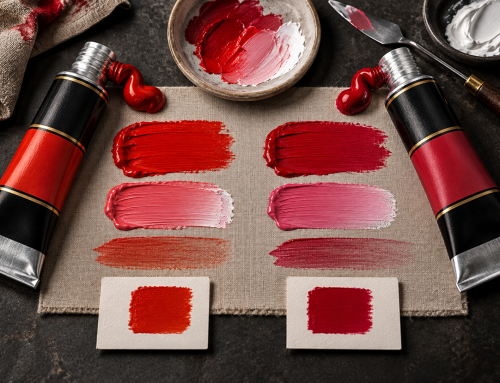
Every addition should create a visible benefit. If two siennas are nearly identical in masstone, tint and glaze, they may not justify separate shelf positions. Conversely, a transparent Burnt Sienna and an opaque red oxide can serve very different techniques despite appearing related on a printed chart.
Compare samples using:
- masstone over white and dark references;
- a thin film to reveal undertone;
- a fixed tint with one white;
- mixtures with selected ultramarine and phthalo blues;
- a warm and cool neutralisation sequence;
- dried samples labelled with pigment and batch.
Phoenix examples include Yellow Ochre, Raw Sienna, Burnt Sienna and Indian Red. These pages represent different products and media; verify the current specification for each rather than treating the colour family as one formula.
Frequently asked questions
Are earth colours always single-pigment paints?
No. Many are single-pigment, but familiar names can also be made from mixtures. Check the Colour Index declaration.
Is Yellow Ochre PY42 or PY43?
PY43 generally identifies natural yellow ochre; PY42 identifies synthetic yellow iron oxide. Paints sold under the same colour name may use either.
Which earth colours are most useful in a compact palette?
Yellow Ochre, Burnt Sienna, Raw Umber and Burnt Umber cover distinct warm, cool and value roles, but the best selection depends on subject, medium and the actual formulas.
Why not mix every brown from primary colours?
Artists can, but earth colours offer convenient, often predictable low-chroma starting points. They can save mixing time and provide characteristic transparency or drying behaviour.
Next step
Explore Phoenix painting colours and contact Phoenix Art Materials for current colour charts, samples and product-specific data.
Editorial sources
Related Posts