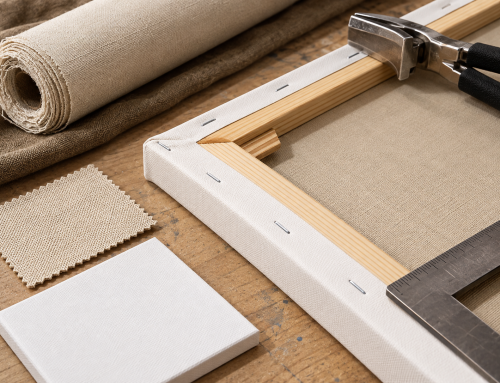
The terms canvas panel and canvas board are often used as if they mean exactly the same thing. In practice, both describe a rigid painting support made by bonding canvas to a firm core, but the edge construction may differ. A canvas panel commonly has fabric wrapped around the sides and secured at the back; a canvas board more often has canvas bonded to the face with clean, flush edges.
That distinction is useful, but it is not universal. Product names vary by country and brand. The safest way to compare two ranges is therefore to look beyond the name and verify five things: the core, the canvas, the ground, the edge construction and the finished flatness.
The basic construction difference
| Feature | Canvas panel | Canvas board |
|---|---|---|
| Typical edge | Canvas wraps around the edge and is fixed to the reverse | Canvas ends at or near the face edge |
| Visual character | Looks more like a thin, rigid canvas | Clean, cut edge; often intended for framing |
| Core | Rigid board, composition board, MDF or another stable substrate | Similar range of rigid cores |
| Painting response | Firm, with little or no bounce | Firm, with little or no bounce |
| Main variables | Corner finish, adhesive coverage, edge alignment | Face bonding, cut quality, exposed core protection |
Jackson’s Art uses this wrapped-versus-flush distinction in its guide to canvas boards and panels, while also noting that the terms are frequently used interchangeably. This is why category buyers should define the construction in specifications instead of approving a product on its commercial name alone.
Why a rigid support feels different from stretched canvas
A stretched canvas has fabric held under tension over an open wooden frame. Pressure from a brush or knife produces some movement or “bounce.” A canvas-covered board supports the fabric continuously, so the surface feels firmer.
That firmness can be useful for:
- detailed brushwork and controlled edges;
- palette-knife work where the artist does not want the surface to flex;
- plein-air studies, colour charts and classroom exercises;
- compact storage when many surfaces must be kept together;
- projects that will be placed in a conventional frame.
It is not automatically better for every artist. Large rigid supports can become heavier than comparable stretched canvases, and the painting experience is different. Product selection should match the user task, not a simplistic “student versus professional” label.
Compare the core, not only the thickness
Two boards with the same nominal thickness can perform differently. Core density, moisture response, internal structure and edge quality affect flatness and durability. Ask the supplier to identify the core and provide tolerances for thickness and finished dimensions.
For sample review, place several panels on a known-flat surface and inspect:
- bowing or twisting before use;
- exposed or crushed corners;
- separation between canvas and core;
- variation in thickness within the batch;
- dimensional consistency across repeated sizes.
Flatness should be assessed after the samples have acclimatised to the intended environment. A single photograph cannot establish how a board responds to changes in humidity or transport.
Examine the canvas and ground as a system
The visible weave is only one part of the surface. Cotton, linen and blended fabrics can provide different textures, but weight and fibre name alone do not predict the final painting response. Priming changes absorbency, tooth, colour and the way paint releases from a brush.
Review the actual coated surface for:
- weave scale and regularity;
- pinholes, skips and visible coating defects;
- excessive absorbency or an overly sealed feel;
- colour consistency across a batch;
- compatibility with the stated painting medium;
- adhesion at the face, corners and reverse edge.
For oil paint, the fabric requires an appropriate barrier and ground so oil does not directly penetrate and weaken the fibres. For acrylic, surface absorbency and tooth still influence handling and appearance. A generic statement such as “triple primed” is less useful than a physical sample plus a clear description of the preparation system.
Edge construction changes merchandising and use
A wrapped panel can present a finished-looking edge, but corners must be neat and consistent. A face-mounted board can be easier to insert into some frames, yet exposed core edges may need careful handling.
For retail or education ranges, compare:
- whether dimensions refer to the core or the finished product;
- how easily the support fits standard frames or pochade-box slots;
- whether labels can be removed without damaging the reverse;
- whether corners remain protected in a multi-pack;
- whether the edge treatment is consistent across sizes.
These details often influence complaints more directly than the category name printed on the pack.
A practical sample approval checklist
Approve samples against a written checklist rather than memory.
| Check | Suggested review |
|---|---|
| Identity | Product name, item code, size and construction match the brief |
| Dimensions | Measure length, width and thickness at more than one point |
| Flatness | Inspect face-up, face-down and on edge |
| Surface | Review weave, ground coverage, tooth and colour |
| Bonding | Inspect face, sides, corners and reverse for lifting |
| Painting trial | Apply the intended medium in thin and heavier passages |
| Packaging | Check corner protection, abrasion and movement inside the pack |
| Batch consistency | Compare multiple units, not a single presentation sample |
Phoenix presents a range of canvas panels with different surface and construction options. Use the collection as a product-range reference, then confirm the current core, fabric, primer, dimensions, packing and availability for the exact item under consideration.
Choosing the right range architecture
A concise assortment may include one general-purpose cotton surface in common sizes. A specialist range can add fine-texture linen, black ground, watercolour-prepared surfaces or shaped formats where there is a defined audience. The commercial logic should be visible: each addition needs a distinct surface, medium, size or application role.
Avoid creating multiple near-identical products that differ only in internal grade names. Artists and retail staff need differences they can see, explain and use.
Frequently asked questions
Is a canvas panel the same as a canvas board?
The names are often used interchangeably. A common distinction is that a panel has canvas wrapped to the reverse, while a board has canvas bonded to the face with flush edges. Always verify the construction.
Are rigid canvas supports suitable for finished paintings?
Yes, when the core, bonding, ground and framing method are appropriate for the medium and intended use. “Board” does not automatically mean temporary or student-only.
Which is better for palette-knife painting?
Many artists prefer a rigid support because it does not flex under pressure. Surface tooth and ground still affect how the paint moves.
What should a buyer request before ordering?
Request current specifications, physical samples, packaging details and product-specific documents. Test multiple units from the proposed construction rather than relying on naming alone.
Next step
Explore the Phoenix canvas panel range and contact Phoenix Art Materials to request current specifications, samples or range information.
Editorial sources
Related Posts