An artist review can reveal how oil paint feels in real use, but it cannot qualify a product range by itself. Buyers should use artist observations to identify the right technical questions, then verify those questions through matched samples, documented test methods, colour-level information, batch controls and applicable safety or compliance records.
Phoenix’s commissioned 5 painting comparison offers a useful example. The artist discussed colour, tinting strength, body, impasto, consistency, opacity, thin application, drying and odour after working with 12 supplied Phoenix Artist Oil colours. He also identified documentation, website and palette-knife concerns. The value of the video is therefore not a simple winner—it is the set of evaluation questions it creates.
Disclosure: Phoenix supplied the artist with 12 oil colours, canvases and palette knives and commissioned the video; compensation may also have been involved. The observations apply to the supplied samples and the studio conditions shown. This was an artist-use comparison, not an independent laboratory qualification.
Read the complete phoenix store web account, Phoenix Artist Oils vs Winsor Newton: Artist’s 5 Painting Comparison, and watch the original commissioned video before using the evaluation framework below.
The direct answer: use four evidence layers
A professional paint decision is stronger when it combines 4 different evidence types.
|
Evidence layer
|
What it can answer
|
What it cannot establish alone
|
|
Artist-use review
|
Handling preference, workflow, application questions and practical objections
|
Formula, universal performance, batch consistency or compliance
|
|
Controlled sample comparison
|
Differences under a defined surface, ratio, film thickness and environment
|
Long-term production consistency unless repeated across batches
|
|
Product documentation
|
Product identity, pigment information, ratings, warnings and applicable specifications
|
Whether the paint suits every artist’s technique
|
|
Supplier and quality controls
|
Traceability, production release, change control and nonconformance handling
|
The artist’s subjective experience
|
The art supplies’ task is not to choose one evidence layer. It is to make them agree—or document why they differ.
-
Convert “vibrancy” into a matched colour comparison
In the video’s limited Zorn-palette-style comparison, the artist did not observe an obvious visual difference in colour vibrancy. This is valuable context, but it does not measure the full colour range.
For a buyer evaluation:
- Match colours by pigment code or comparable palette role.
- Record the surface, ground, batch and lighting.
- Apply full-strength masstone and a controlled thin drawdown.
- Photograph with a colour target under fixed lighting.
- Evaluate wet and defined dry states.
- Separate camera appearance from direct physical observation.
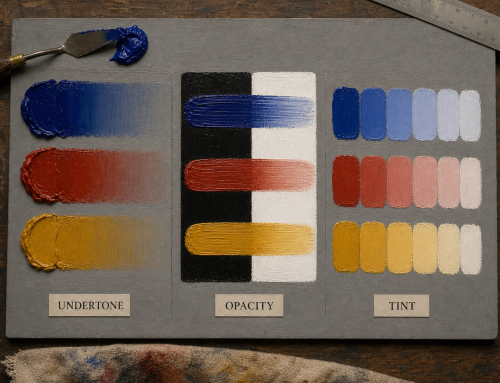
Two colours with similar names may use different pigments. Masstone can also appear similar while undertone, opacity and tints differ. Read Colour Names vs Pigment Codes before creating the comparison set.
-
Separate tinting strength from pigment load
The artist felt that Winton had a slight advantage in perceived pigment load or tinting strength, while practical painting results appeared close. These terms must not be treated as synonyms.
- Tinting strength is an observable mixing behaviour: how strongly one paint changes another.
- Pigment load concerns the amount or concentration of pigment in a formulation and cannot be calculated reliably from appearance alone.
- Body, opacity, pigment type, particle properties and dispersion can all affect perceived strength.
A buyer test should use:
- equal masses rather than approximate brush dabs;
- the same white paint and batch;
- a documented paint-to-white ratio;
- at least three tint steps;
- matched pigment roles;
- consistent mixing and application;
- colour-managed capture.
The result can compare tint behaviour. It should not claim a percentage pigment load unless the supplier provides suitable formulation or analytical evidence.
-
Treat body and impasto as application fit
The artist preferred Winton’s stiffer body for raised impasto marks. Phoenix remained workable for impasto, but the handling profile did not match his preference as closely.
This is not a universal quality ranking. Buyers should first define the intended application:
|
Intended use
|
Useful handling questions
|
|
Direct brush painting
|
Does the paint release predictably and retain intended marks?
|
|
Palette-knife impasto
|
Does it hold ridges at the agreed film thickness and temperature?
|
|
Broad coverage
|
Does it spread without excessive medium for the target user?
|
|
Thin passages
|
Does the colour remain useful when spread under a controlled method?
|
|
Teaching or general retail
|
Is handling understandable across the proposed starter palette?
|
Record temperature, storage condition, application tool, surface and medium. A “thicker” paint is not automatically better; it may simply suit a different artist.
-
Test consistency across colours—and across batches
The artist identified relatively consistent handling across the 12 supplied Phoenix colours as the strongest positive observation.
For a buyer, that observation creates two separate questions:
- How consistent is the user experience across different colours in the proposed set?
- How consistently does each colour meet its own approved specification across production batches?
These are not the same. Pigments naturally differ in oil absorption, opacity, texture and drying behaviour. A credible quality system does not force every colour to become identical; it controls each colour to an appropriate reference.
Request:
- exact sample and batch identification;
- approved colour or formula reference;
- consistency/rheology method where shareable;
- retained-sample process;
- acceptance limits or comparison logic;
- results from more than one relevant batch before making range-wide claims.
The safe public wording remains: the artist found the 12 supplied colours relatively consistent in handling. Do not convert this into “every Phoenix colour and batch has identical viscosity”.
-
Verify opacity colour by colour
The video showed favourable covering behaviour for selected cadmium-hue samples from both ranges. Opacity, however, is colour-specific and application-dependent.
Use a controlled black-and-white drawdown:
- apply a documented wet-film thickness;
- use the same tool and pressure;
- identify pigment codes and hue status;
- record surface and ground;
- assess after a defined drying interval;
- retain the physical card.
A general catalogue statement cannot replace colour-level opacity information. Winsor & Newton’s current Winton colour table illustrates one way to separate colour name, opacity, permanence, lightfastness, pigment codes, series and vehicle oil.
-
Do not call a thin passage a complete glazing test
The artist found that Phoenix retained useful visible colour when spread thin. That suggests potential for thin applications.
A glazing claim requires more:
- a fully dry lower layer;
- identified transparent or semi-transparent colours;
- documented medium and dilution;
- controlled film thickness;
- evaluation across multiple layers;
- assessment after drying.
Until this is completed, use thin-application observation, not proven glazing performance.
-
Standardise drying before comparing brands
The artist observed that the tested Phoenix samples appeared to stabilise sooner under his studio conditions, including his day-six check. That is a useful hypothesis, not a universal drying-time specification.
Oil-paint drying varies with:
- pigment;
- vehicle and additives;
- film thickness;
- surface absorbency and ground;
- medium use;
- temperature, humidity, airflow and light;
- the definition of touch-dry, stable or ready for overpainting.
For a buyer comparison, match pigments or roles, weigh samples, apply a controlled film, record conditions and define the endpoint before testing. Repeat the test across relevant colours and batches.
Do not place dries in six days on a product page or quotation based only on the commissioned video.
-
Keep odour and safety evidence separate
The artist did not notice a strong unpleasant odour from either paint group. Odour may affect studio comfort, but it cannot establish toxicity, solvent content, VOC level or overall safety.
For the target product and market, request:
- current SDS;
- colour-specific warnings where applicable;
- label review;
- applicable test or conformity documentation;
- disposal guidance;
- revision and change-control information.
An organisation-level certificate or a generic SDS should not be presented as proof for every colour and market. Technical and regulatory owners should verify the scope.
The negative feedback is part of the buyer evidence
The review also raised concerns about:
- Phoenix SDS information appearing too general;
- product information and navigation on the retail site;
- availability compared with Winton in the artist’s market at that time;
- rough edges on the supplied palette knives;
- the fact that the supplied canvases were not actually tested.
These points should not be removed from a B2B interpretation. They reveal four supplier-evaluation principles:
- Product performance and information quality must be assessed separately.
- Accessory feedback should be routed to the correct SKU, batch and quality process.
- Untested supplied products cannot inherit evidence from the tested paint.
- Market availability is time- and region-specific, not a permanent product-quality conclusion.
A buyer workflow from review to approval
Step 1 — Define the product and channel
Record the intended artist, market, series, colours, sizes, set/open-stock structure, channel and required documentation.
Step 2 — Create the test plan
Turn each artist observation into a question, method, sample count, owner and acceptance decision.
Step 3 — Match and identify samples
Record colour, pigment code, batch, surface, film method and comparison rationale. Do not compare only by familiar colour name.
Step 4 — Run colour and handling tests
Complete masstone, undertone, opacity, tint, mixing, body and drying observations under documented conditions.
Step 5 — Review documentation
Check product specification, colour chart, SDS, label fields, rating legends and applicable compliance records.
Step 6 — Approve a controlled reference
Retain the approved drawdowns, complete set or golden sample with version, date and authorising reviewers.
Step 7 — Define reapproval triggers
Agree which formula, raw-material, component, artwork, production-site or document changes require notification or new samples.
Continue with the detailed oil colour and oil paint stick supplier-evaluation checklist and custom artist colour-set sample approval workflow.
Buyer scorecard: use gates, not one vague percentage
|
Gate
|
Pass question
|
Evidence
|
|
Product identity
|
Do quoted, sampled and documented products match?
|
SKU, series, colour, pigment and batch references
|
|
Technical fit
|
Do the samples meet the intended artist and channel needs?
|
Controlled drawdowns, tints, mixtures and handling records
|
|
Documentation
|
Are colour, rating, safety and label fields usable and current?
|
Approved chart, specification, SDS and artwork
|
|
Packaging
|
Does the physical product protect, identify and replenish correctly?
|
Mock-up, closure/seal checks, barcode and transit review
|
|
Repeatability
|
Can the approved result be controlled in production?
|
QC method, retained sample, traceability and change control
|
|
Commercial fit
|
Are price, quantity and timing acceptable for the defined scope?
|
Quotation based on the matched approved specification
|
A commercial comparison becomes meaningful only after the technical scope is aligned.
The takeaway
An artist review is strongest when it generates better questions rather than an exaggerated winner claim. Use the artist’s real painting experience to identify colour, handling, documentation and quality concerns; then verify those concerns with matched samples, controlled methods, current technical records and repeatable approval controls.
Explore Phoenix Oil Colour or contact Phoenix Art Materials to discuss current product documentation and a sample evaluation. Final specifications, tests, custom scope, quantities and timing must be confirmed for the individual project.
FAQ
Can an artist review qualify an oil-paint supplier?
No. It can reveal useful handling observations and buyer questions, but qualification also requires matched samples, documentation, quality controls and project-specific commercial review.
Is tinting strength the same as pigment load?
No. Tinting strength is an observable mixing behaviour. Pigment load concerns formulation and cannot be calculated reliably from visual strength alone.
How should buyers compare oil-paint consistency?
Evaluate the intended handling relationship across colours, then test each relevant colour against its own approved specification across batches.
Can a six-day studio observation become a drying-time claim?
No. A published drying specification needs a defined method, endpoint, colours, film thickness, surface, environment and repeatability evidence.
Should negative artist feedback remain in a supplier article?
Yes, when it is accurately attributed and scoped. It helps buyers identify documentation, quality-control and product-information questions.
What is the next step after a promising studio review?
Create a matched sample plan, request current documents, run controlled comparisons and approve a traceable reference before commercial release.
Related Posts