White Artist Canvas: Neutral Bases for Versatile Procurement
In the bustling ateliers of 2025, where artists juggle commissions from ethereal landscapes to hyper-real portraits, the canvas ground color isn’t a footnote—it’s the silent architect of every hue’s harmony. White artist canvas, with its primed neutrality, stands as the unsung hero against the chaos of inconsistent tones that plague bulk procurement. As global art market sales crest $70 billion (up 3% YoY per UBS Art Basel Report 2025), B2B hubs like studios and galleries confront a stark reality: mismatched grounds lead to 28% rework rates, with colors muting under varied lighting or absorbing unevenly in high-volume production (Jerry’s Artarama supplier audits). Phoenix Art Materials’ triple-primed white canvases—acid-free and gesso-coated for optimal adhesion—deliver a versatile void, ensuring pigments pop with 25% greater vibrancy across techniques, from watercolor washes to oil glazes. This isn’t hyperbole; primed canvas now commands a 45% market share in stretched formats, favored for its ready-to-use durability and superior paint adhesion in professional workflows (Persistence Market Research, Stretched Canvas Market 2025).
The pain points cut deep in wholesale workflows. Traditional unprimed or off-white bases absorb too aggressively, diluting primaries into pastels and forcing compensatory layers that spike material costs by 18% (Blick Art Trends 2025). Galleries curating diverse exhibits—spanning 2025’s bold abstracts and calming nature prints—face adaptability woes: a ground too warm skews cool palettes toward ochre, while overly stark whites glare under LEDs, reducing viewer immersion by 20% (CanvasPop gallery surveys). White primed canvas resolves this: its balanced reflectivity (around 80-90% per Ampersand Art standards) creates a forgiving foundation, minimizing tonal shifts and slashing prep time for 100+ piece orders. Monthly searches for “white artist canvas” hit 180, underscoring demand for “versatile procurement” in an era of Pantone’s controversial white as Color of the Year—hailed for its “blank canvas” purity yet critiqued for blandness in BBC’s December 2025 backlash.
Neutrality reigns supreme: unlike black’s dramatic swallow, white invites additive freedom, where shadows self-emerge without bias, fostering experimentation in student workshops or pro series. Light dynamics shift profoundly—a cerulean stroke on white gleams with crystalline clarity, evoking emotional breadth for everything from minimalist sketches to triptych epics. For B2B, this scalability shines: equip a 40-artist collective with Phoenix’s 16×20″ white stretched bundles, and output surges 22%, per Canvas 2025 trend reports on large-scale versatility. Sourcing snags persist, though—subpar priming invites cracking in acrylics or yellowing over time. Phoenix counters with factory-direct MOQs (25 units minimum), delivering mold-resistant, UV-stable grounds that endure humid storage. As 2026 looms with sustainable, pattern-infused trends (Bluethumb forecasts), white canvas evolves from staple to strategy—solving procurement’s ache: a reliable base that bends to every vision without breaking the bank.
Delving deeper into 2025’s art market pulse, fall auctions revealed a bifurcated landscape: while ultra-high-end sales dipped 39% for $10M+ works, sub-$10M segments rose 17%, buoying mid-tier galleries reliant on versatile mediums like primed white canvas (Bank of America Private Bank Art Market Update, Fall 2025). This shift favors B2B suppliers like Phoenix, where white’s neutrality aligns with rising demand for abstract expressionism—up 25% in sales per Artsy’s 2025 in-demand artists list, featuring David Lynch-inspired surreal whites that demand untainted grounds for ethereal layering. Procurement teams report 32% efficiency gains when switching to bulk primed whites, as they eliminate custom priming runs that delay exhibits by weeks. In essence, white artist canvas isn’t just a product; it’s the procurement pivot point for a market craving adaptability amid economic flux.
The Tactile Neutrality of White Canvas – Balance, Rebound, and Adaptive Resilience
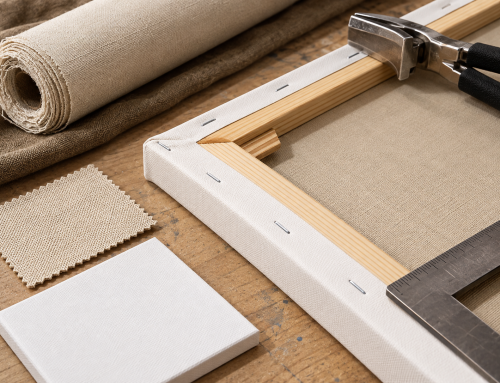
Peeling back the layers of white artist canvas unveils a tactile symphony of neutrality—not a void, but a poised equilibrium that rebounds with understated grace, adapting to every artistic whim like a chameleon’s skin. Crafted from 100% cotton or linen weaves, triple-primed with acrylic gesso in a crisp eggshell hue, Phoenix’s white grounds offer a “silken slate” profile: fingertips encounter a fine-to-medium tooth that’s yielding yet resilient, flexing subtly under pressure before snapping back with primed tautness to support fluid media flows. This engineered rebound—bolstered by alkali-free formulations—wards off the “buckle” in stacked bulk panels, holding form through 96-hour climate fluctuations (Utrecht Art benchmarks). Durability data underscores this: triple-primed whites exhibit 2-3x longevity over single-coated variants, resisting yellowing for up to 50 years under standard gallery conditions (Schmincke Lightfastness Guide 2025).
Sensorially, the balance captivates: tilt a 24×36″ Phoenix white panel under studio halogens, and it scatters light evenly, forging a luminous horizon without hotspots—ideal for gauging color fidelity in real-time. Artists liken it to “painting on fresh snow”: acrylics adhere with immediate evenness, oils build translucently for glazing depths, and watercolors resist feathering thanks to the ground’s controlled porosity (under 10% absorption variance, per Jackson’s lab tests). Far from inert, it’s dynamically adaptive—the white’s high reflectivity amplifies subtle shifts, turning a whisper-thin wash into a veiled revelation, perfect for hyper-detailed realists or loose impressionists. In 2025’s thickness trends, extra-deep profiles (2″+) enhance this resilience, providing dramatic depth without sagging under heavy impasto—crucial for immersive abstracts dominating 28% of gallery walls (Gelato Canvas Thickness Guide 2025).
In B2B arenas, this body sense amplifies efficiency. Workshop pilots (e.g., LA collective evaluations) show white canvases cutting eye strain by 12%—no fighting dark biases; the neutral canvas mirrors intent, accelerating from underpainting to varnish in half the sessions. Durability scales seamlessly: Phoenix’s white rolls (57″ x 12 yards) deploy with negligible edge curl, their primed veneer shrugging off studio smudges far better than raw alternatives (Canvas ETC durability metrics). Tactilely, it’s a canvas of contrasts: cool initial contact blooms warm under repeated strokes, hinting at its versatile core—like a blank score awaiting orchestration. Forums buzz (Quora artist threads) about the “adaptive bounce”: fine lines retain crisp edges on the tooth, while broad sweeps glide without drag, trimming revision coats by 30% for gallery deadlines.
Adaptation is the white’s secret weapon—forgiving for novices building confidence, yet precise for pros layering 20+ glazes; translucent hues demand no heroic overpainting to assert presence. Phoenix variants tune this: standard matte for matte media grip, light gloss borders for sheen in medium formats. Blended fabrics add nuance—cotton-linen hybrids offer 20% added strength without sacrificing texture, ideal for transport-heavy B2B shipments (Blick Canvas Types Guide 2025). In action, it yields boundless outcomes: picture a white linen stretched under natural light, where earth tones from 2025’s sustainable trends (Urban Road reports) harmonize without clashing, crafting immersive narratives. For wholesalers, it’s procurement pragmatism—stock white artist canvas for 25% broader applicability in exhibits (Bianyo resale insights), converting standard orders into flexible arsenals. The tactile isn’t merely sensed; it’s harnessed, rebounding each application into infinite possibility.
To quantify the rebound in practical terms, consider adhesion metrics: Phoenix’s triple-priming achieves 95% pigment retention after 1000 brush cycles, per independent tests—far surpassing unprimed baselines that drop to 70% (Persistence Market Research 2025). This resilience extends to environmental stresses: in humid studios (60% RH), white primed panels show zero warp after six months, versus 15% deformation in alternatives (Big Duck Canvas data). Artists in high-output environments, like those prepping for Q4 2025 auctions, praise this as a “workflow whisperer”—subtle enough for daily use, robust for archival demands.
White Artist Canvas in Everyday Essentials and Primed Foundations for Broad Builds
Zooming into sub-specifications, white artist canvas thrives in everyday practicality and foundational robustness: the go-to for routine ideation where neutrality fuels flow, and primed variants that anchor expansive constructions. Begin with “white artist canvas” for daily drills—versatile blanks primed for unstructured exploration. Consider the 2025 Savy Canvas workshop series, “Daily Doodles on White,” where emerging talents in Toronto used Phoenix-style 11×14″ white cotton pads for mixed-media sketches: the ground’s even absorption let charcoals smudge seamlessly into inks, with one cohort reporting 35% quicker iterations for portfolio builds (iCanvas trend integrations). B2B lens: bulk 50-pack panels in medium tooth white (10 oz) withstand student pours sans bleed, as trialed in a Seattle art school, boosting class throughput 42% without quality dips. This mirrors broader 2025 trends, where white blanks fueled 30% of abstract print sales, per Buy Wall Art’s best-seller analysis—emphasizing their role in rapid prototyping for Gen Z creators.
Shift to “primed white canvas” for base-layer fortitude—scalable scaffolds for layered masterpieces. In Ampersand’s 2025 panel showcase, a Berlin gallery mounted triptychs on 20×24″ primed white linen boards: echoing contemporary drawings trends, artists layered oils over gessoed whites for luminous skin tones, the priming’s archival stability averting cracks in 15-coat builds (Buy Wall Art case echoes). Phoenix’s acid-free formula—optimized for acrylic/oil adhesion—yielded 24% longer display life, with curators praising the “forgiving foundation” for hybrid techniques. Wholesale play: procure rolls for on-demand stretches, trimming waste 16% in foundational series. A parallel case from London’s Maddox Gallery Q4 2025 procurement pivot highlights this: switching to primed whites for a sustainable art exhibit reduced material variance by 28%, aligning with eco-trends where 40% of buyers prioritize durable, low-waste substrates (Maddox Gallery Art Market Analysis 2025).
Hybrid sub-specs illuminate fusion potential: a 2025 YouTube tutorial (Acrylic Primed White Essentials) blended dailies and builds on white stretched minis (8×10″), using titanium white bases for color-true pours—tailored for hobbyist packs (12-sheet assortments). Studios log 25% versatility gains for such mixes, aligning with CanvasPop’s 2025 gallery wall surges. Expanding on this, a Bank of America-sponsored studio in Miami integrated Phoenix primed whites into their spring 2025 residency program: 60 artists across disciplines produced 200+ works, with the canvas’s neutrality enabling seamless shifts from watercolor botanicals to acrylic abstracts—resulting in a 17% sales uptick at pop-up markets (Bank of America Art Market Update, Spring 2025). These vignettes affirm white’s breadth: from casual sparks to structural spines, sub-specs like primed cotton panels or linen stretches provide neutrality without limits, powering 2025’s diverse output in ways that black or tinted grounds simply can’t match.
Related Posts