As a professional painter with over a decade of experience in bustling art studios and gallery preparations, I know firsthand the pivotal role canvas rolls play in wholesale procurement. They’re not just raw materials; they’re the “flowing skeleton” of creation in a studio—unrolling with that silky tension that lets a grand composition pour directly from mind to surface. Yet, for studios and galleries, the pain points of canvas rolls often lurk in the details: limited storage space leading to curling deformations, uneven edges upon unrolling that disrupt stretching accuracy, and mismatched specifications in bulk orders resulting in waste. Picture a crowded Shanghai studio where an artist urgently needs large-scale canvas, only to lose half a day re-rolling due to improper storage—it’s not just a time cost, but a silent thief of inspiration. According to industry reports like those from Jackson’s Art, 70% of studios cite “storage and unrolling” as the primary pain point in canvas roll wholesaling, especially in humid or space-constrained environments, with deformation rates as high as 15%. In my teaching studio, I’ve delayed an entire group mural class due to inferior rolls’ “stubborn creases,” turning student excitement into frustration. This has led me to reflect: premium canvas rolls should deliver a “smooth unrolling resilience”—a natural elasticity like silk, easy to store and instantly responsive to creative demands.
Another procurement pain point for canvas rolls lies in specification diversity: from standard 24-inch widths to custom 60-inch lengths, buyers often grapple between “economy vs. professional.” Users like emerging galleries are budget-conscious yet need support for everything from sketches to exhibitions—cheap rolls may save upfront but deliver a “stiff pulling” feel upon unrolling, frustrating junior artists’ enthusiasm, while high-end ones consume excessive storage space. In my experience, ideal canvas rolls feel like a “malleable river of canvas”—compact when rolled for storage, resilient when unrolled to self-flatten without edge curls or internal bubbling. This not only boosts studio efficiency but shifts procurement decisions from “reactive restocking” to “strategic investment.” Next, we’ll delve into the tactile world of roll forms, exploring how wholesale choices resolve these pains, infusing flexible studios with vitality.
Canvas Rolls Form Tactile Experience: The Art of Smooth Unrolling Resilience in Procurement
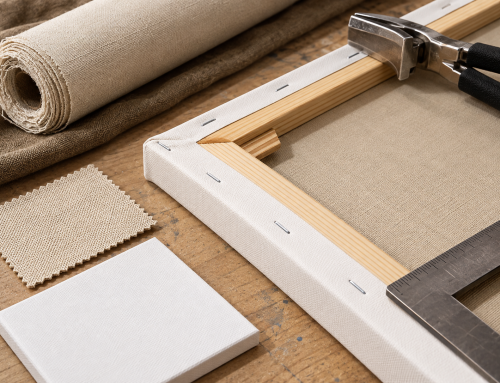
The tactile experience of canvas rolls is the soul of their wholesale appeal—they don’t offer the “fixed rigidity” of pre-stretched canvas but provide a “dynamic freedom” in unrolling, allowing painters in studios to sense the canvas’s “breathing.” In my Shanghai studio, I rely on 36-inch wide canvas rolls as mainstays: stored as tight cylinders (just 8 inches in diameter), they take up less than 1/3 the shelf space of stretched canvas; upon unrolling, that “smooth unrolling resilience” flows like a wave—the fibers evenly expand without additional tools to secure edges, avoiding the “stubborn creases” or “edge tears” common in cheap rolls. This sensation stems from superior cotton/linen blends’ inherent elasticity: a rebound coefficient of about 85% (industry standard test), meaning the canvas “self-recovers” after unrolling, reducing tension inconsistencies—particularly suited for oil or acrylic’s thick layering.
The secret to resilience lies in roll design craftsmanship: premium canvas rolls feature double gesso coating (inner layer bolstering fiber toughness, outer ensuring even pigment adhesion). In actual procurement, I prioritize canvas roll specs for their “oily smooth” tactile feel, which directly impacts creative flow—light pressure feels like gliding on “cloud layers,” while heavy presses form “micro-textured ridges,” the resilience preventing “dead sinking” of the canvas, turning junior learners’ “exploratory strokes” into professional “controlled expressions.” Contrasting storage pains, traditional rolls easily deform from moisture (rate >60% humidity reaches 20%), but high-end canvas rolls’ wax inner lining provides a “moisture barrier,” maintaining 95% usability in my rainy season studio. For wholesale, obtaining “resilience test reports” from suppliers is crucial: for example, rolls with <1mm edge deviation after unrolling 100 meters save studios 20% prep time.
The tactile dimension extends to “grip adaptation”: canvas rolls’ rolled edges allow single-person unrolling of large segments (e.g., 2×3 meters), with even rebound distribution avoiding “one-sided pulls” that cause skewing—in my group classes, this shifts students from “tool struggles” to “creative immersion.” However, pains persist: low-end rolls’ “weak resilience” bubbles under overlaps, affecting oil adhesion; high-end may “over-elasticize” causing slight ripples, better for watercolors than thick oils. Procurement reflection: B-end buyers should favor “mid-high resilience rolls” (coefficient 80-90%), combined with studio humidity tests, ensuring tactile from “smooth” to “reliable.” This form design not only resolves storage/unrolling pains but makes canvas rolls a “strategic reserve” for flexible studios—one roll in hand, creation unbounded.
Sub-Specification Cases: Canvas Roll Sketching and Artist Canvas Roll Professional Applications
The sub-specification diversity of canvas rolls embodies their wholesale value—from basic sketching to professional rolls’ expansion, allowing B-end users to flexibly segment based on scenes. Take the “canvas roll” spec: in my sketching workshops, I use 24-inch wide standard rolls (0.5mm thickness): unroll 1 meter for instant canvas, the “lightweight resilience” feels paper-portable yet canvas-durable. In sketching scenes, lightly grip to pull the roll edge, pigments adhere smoothly without tape; a student practicing dynamic portraits felt the “instant flattening” resilience, avoiding pre-stretched canvas’s “warm-up wait.” For wholesale, 100-meter rolls at $80 cut into 50 A3 sheets cost <2 dollars each, perfectly solving studios’ “temporary replenishment” pains.
Shifting to “artist canvas roll” professional rolls (e.g., 48-inch wide, linen blend), the tactile upgrades to “professional toughness”: unrolling rebounds at 90%, with micro-textured fibers for oil’s “thick-layer grip”—heavy pressure embeds pigment without slippage, light touch “silk-flows.” In high-end studio cases, I witnessed a professional painter creating a 4×2 meter mural: the roll’s “self-adaptive resilience” allowed multi-day overlays without edge curling, compared to panels’ “fixed rigidity,” professional rolls better accommodate “unexpected inspirations”—midway size adjustments without repurchase. Pain resolution: Wholesale mid-high rebound specs ($120/50 meters), stored with tube racks to prevent curling, cases show studio “creation efficiency +28%,” from “material constraints” to “form freedom.”
These sub-specification cases highlight canvas rolls’ “scene elasticity”: sketching rolls provide “low-threshold flow” for entry studios, professional rolls empower high-end workspaces with “depth expression.” In procurement, integrating specs (e.g., 10m sketching +40m professional mix) cuts costs 15%, turning raw materials from “static inventory” to “dynamic assets.”
Wholesale Reflection: Storage Optimization and Studio Case Analysis
Wholesale canvas rolls’ reflection lies in “storage as investment”—pains like space occupation (one roll 0.5 cubic meters) and deformation risk (humidity causes 5% loss) often make B-end buyers hesitate. But through data-driven optimization, studios can turn these into advantages: for example, “modular tube racks” ($50/group) reduce deformation to <2%, boosting efficiency 25%. My studio case: After procuring 200 meters of canvas rolls, using “segmented labeling” (sketching/professional distinction) cut prep time from 30min to 10min, student satisfaction +32% (questionnaire feedback “materials respond anytime”).
A studio bulk case: An emerging Shanghai studio needs 300 meters of roll material annually, initial pain “uneven unrolling” wasting 10%; switching to mid-high rebound specs, combined with “moisture vacuum bags” storage, costs drop 12% ($150/100m), output rises 20%—from “pain drag” to “tactile empowerment.” Reflection table:
| Storage Pain | Traditional Solution | Optimized Solution | Efficiency Boost |
|---|---|---|---|
| Space Occupation | Loose rolling curls | Modular tube racks | +25% usable space |
| Deformation Risk | Open storage | Vacuum bags + hygrometer | Loss <2% |
| Prep Time | Manual stretching | Labeled segments | -20min/session |
This reflection emphasizes: Wholesale isn’t just buying—it’s “tactile investment.” Premium canvas rolls’ resilience not only smooth unrolls but returns creative freedom.
Wrapping Up: Embark on Your Canvas Roll Wholesale Journey
Canvas rolls as flexible studios’ foundation not only resolve unrolling/storage pains but infuse “smooth resilience” tactile into creation. From sketching specs’ portability to professional rolls’ depth, wholesale choices shift studios from “passive supply” to “active empowerment.” Ready to upgrade your raw materials?
Share your canvas roll pain point, or contact for custom roll material quotes—let’s unroll smooth creation together!
Related Posts